
The Art of Zao Wou-Ki and Why It’s Highly Valuable
Zao Wou-Ki’s paintings breathe across cultures, merging the lyricism of Chinese ink with the audacity of European abstraction. This fusion, coupled with rare material mastery and sustained institutional acclaim, makes his work a cornerstone for discerning collectors.
The Quiet Infinity of Zao Wou-Ki
Few artists achieve a truly transnational visual language. Zao Wou-Ki (赵无极) did exactly that, forging a world where light, gesture, and silence hold equal weight. His canvases do not depict landscapes as much as they summon them—vast territories of memory and breath, where horizons dissolve into color and line. For collectors, this makes Zao’s art both historically resonant and emotionally immediate: a body of work that speaks fluently to East and West, past and present, and that has proved remarkably durable in the market.
Between Traditions: China and Paris
Born in China and establishing his career in Paris, Zao Wou-Ki inhabited a cultural confluence. He absorbed the ethos of ink painting—the primacy of gesture, spatial breath, and the meditative choreography of mark-making—while embracing the possibilities of oil and the experimental currents of European abstraction. The result is not a hybrid for novelty’s sake but a deeply personal synthesis. In his hands, the calligraphic line sheds semantic burden and becomes pure energy; color is no longer merely descriptive but elemental; space unfolds not as a window but as an atmosphere.
Collectors respond to this layered identity. Works that carry markers of his Chinese heritage (subtle references to oracle-bone script, calligraphic rhythm, a reverence for negative space) combined with an assured command of Western materials stand at the intersection of cultural heritage and modern experimentation. In a global art market increasingly attentive to cross-cultural narratives, Zao’s paintings embody one of the most eloquent examples.
A Visual Language of Light and Motion
Zao’s paintings often read like symphonies of light: cadences of pale azure interrupted by incandescent oranges; charcoaled passages puncturing a luminous field; a hush of grey-green opening into radiant white. He allows viewers to perceive time inside a single painting—something volatile and stormlike beside something slow and contemplative. Many works are titled by date, indexing his process as a lived continuum rather than a fixed theme, and underscore the sense that each canvas is a diary of energy.
To glimpse the breadth of his vision and its consistency across periods, explore a curated selection from Zao Wou-Ki (赵无极) below.
Featured Works
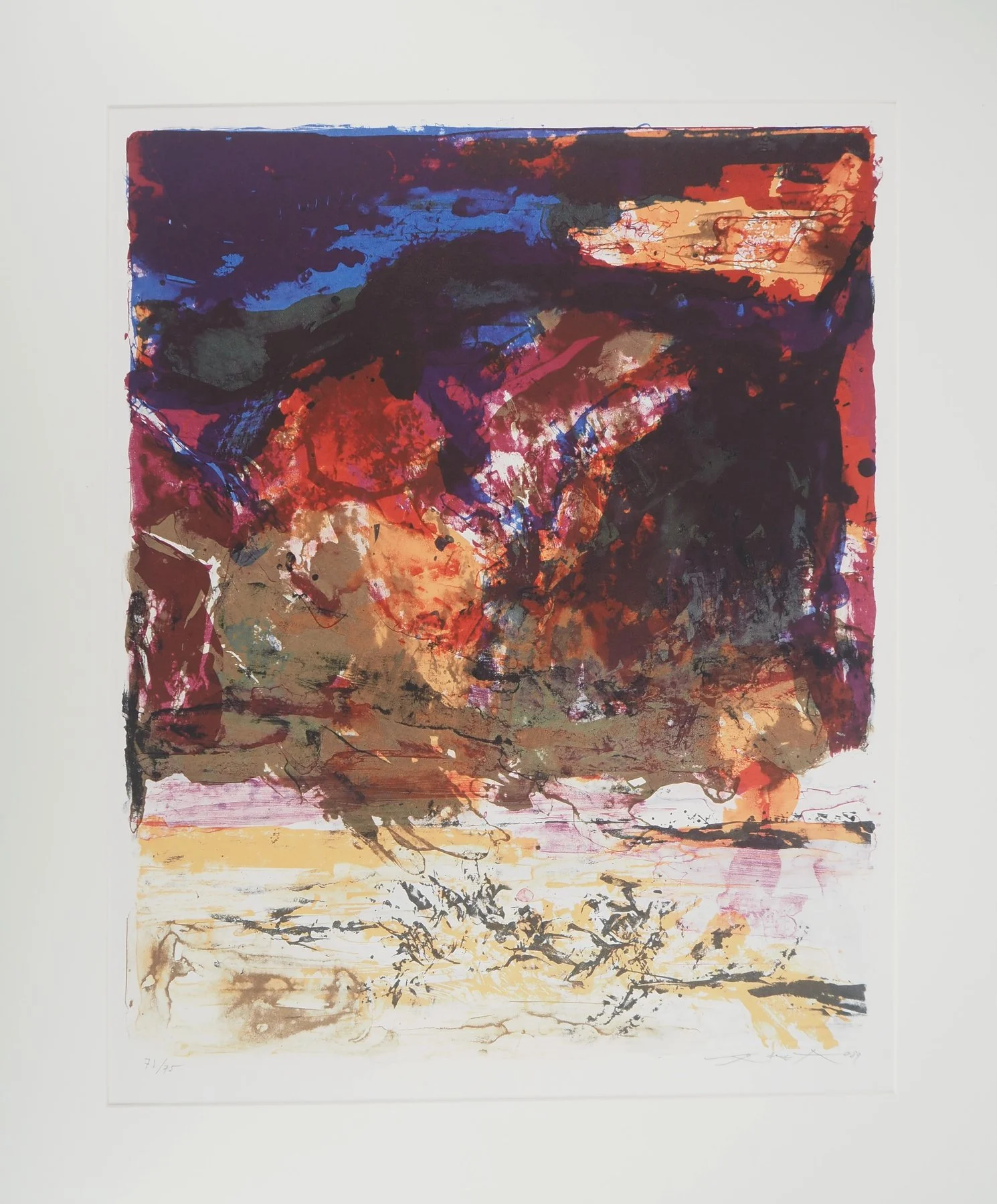
Material Intelligence: Techniques Rooted in Gesture
Beyond atmosphere, Zao’s value lies in the sophistication of his craft. He layered thin glazes that achieve chromatic depth without muddiness; he wiped, re-wetted, and re-energized passages to avoid static build-up; he let brushwork breathe, so the underlying strata remain readable. This is painting that prizes precision without rigidity, intuition without chaos—an exacting balance that only a handful of practitioners maintain over decades.
Scale is integral. Zao’s large canvases create a physical encounter akin to standing before weather or music. Yet even in works on paper and ink, his command of rhythm and pause is explicit. He understands how to activate edges, how to let a painting lean into its margins rather than collapse into the center. For collectors, this sophistication translates into enduring freshness: the work remains responsive under different lights, in different rooms, and across time.
Space, Breath, and Emotion
The emotion in Zao Wou-Ki’s work is not theatrical; it is elemental. His paintings often conjure the sensation of standing at the threshold of something—dawn, weather, a memory long rehearsed. Negative space is not a void but a reservoir of breath. The encounter feels quietly transformative, and that makes his work compelling for lived environments. These are paintings that do not dominate the room; they deepen it.
Collectors quickly learn that this emotional register differs from overtly figurative narratives. It’s a kind of meditative intensity—grounded in lived experience yet open enough to absorb the viewer’s own feeling. Works that balance luminous openness with gestural complexity tend to be the most sought-after: they offer both immediate beauty and long-term inquiry.
Why Collectors Value Zao Wou-Ki
- Cultural significance: Zao bridges major art-historical traditions and contributes to the story of global abstraction. - Technical mastery: His command of oil and ink, glazing, and gestural composition yields paintings with uncommon depth and longevity. - Institutional recognition: Sustained museum presence and scholarly attention have cemented his reputation. - Market resilience: His work has enjoyed steady demand across continents, with benchmarks established at leading auctions and galleries. - Scarcity at quality: Mature, large-scale works with strong provenance and exhibition history can be rare, supporting valuation.
In a market that increasingly rewards narrative depth and material intelligence, Zao’s work aligns with collector priorities. The paintings feel contemporary in sensibility while carrying historical gravitas, making them appealing across generations and geographies.
A Collector’s Checklist
- Period and palette: Consider how the work’s date and chromatic architecture align with your aesthetic priorities. Many collectors favor canvases where luminous fields meet incisive gestural passages. - Scale and presence: Large works can anchor a collection, but exceptional works on paper also demonstrate his core language with remarkable clarity. - Provenance and exhibition history: A solid paper trail enhances both confidence and long-term value. - Condition and surface: Zao’s layered surfaces are part of the magic; ensure they are preserved without over-cleaning or flattening. - Emotional fit: The best acquisitions are not only theoretically sound; they hold your gaze and expand your sense of space.
Enduring Relevance
The art of Zao Wou-Ki (赵无极) remains vital because it models how an artist can carry the weight of tradition while speaking in a thoroughly contemporary voice. His paintings teach us to see beyond borders—between media, schools, and territories—and to recognize that value resides not just in rarity or reputation but in an artwork’s sustained ability to move us. In that sense, the collector’s reward is dual: a significant cultural artifact and a companion for a lifetime of looking.