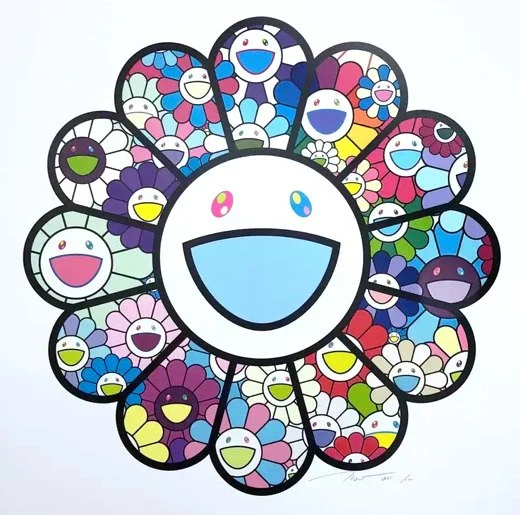
Flowers in Pastel Colors (2022), Edition 100, Handsigned by Takashi Murakami
Flowers in Pastel Colors (2022) by Takashi Murakami – an iconic Flower motif rendered in vivid pastel tones. Hand-signed and numbered silkscreen (50 × 50 cm), edition of only 100. Sealed in its original packaging, sourced directly from Kaikai Kiki.
About This Artwork
Takashi Murakami (*1962, Tokyo) is one of the most influential contemporary artists of our time. Founder of the Superflat movement, he merges Japanese traditions with anime, manga, and pop culture. His works are held in major museums and feature in high-profile collaborations with brands like Louis Vuitton and artists like Billie Eilish.
The silkscreen “Flowers in Pastel Colors” (2022) presents Murakami’s iconic smiling Flower motif in a vibrant pastel palette. The piece is part of a strictly limited edition of 100, hand-signed and numbered, and remains in excellent, unframed condition.
- Technique: Archival pigment print + silkscreen
- Size: 50 × 50 cm
- Year: 2022
- Edition: 100 (n/100)
- Signature: Hand-signed & numbered
- Provenance: Direct from Kaikai Kiki Store (Tonari no Zingaro), Japan
- Condition: Brand new, sealed in original packaging, never framed
A work that perfectly embodies Murakami’s colorful universe – a collector’s gem with impeccable provenance.
You May Also Like

Flower #1480 “Shampoo Hat”, Special Print SP 6/25, handsigned (2023)
Takashi Murakami (*1962, Tokyo) is one of the most influential contemporary artists of our time. Founder of the Superflat movement, he merges traditional Japanese aesthetics with elements from anime, manga, and global pop culture. His works are held in major museums worldwide and include high-profile collaborations with Louis Vuitton, Supreme, and Billie Eilish. The silkscreen print “Flower #1480 Shampoo Hat” (2023) features Murakami’s iconic Flower character rendered in a playful pixel-art style. This piece comes from a highly limited Special Print edition (SP 6/25) – produced in addition to the regular edition of 100 prints. This rarity makes it a highly desirable collector’s item with strong long-term potential. Technique: Sparkling silkscreen Size: 50 × 50 cm Year: 2023 Signature: Hand-signed & numbered (SP 6/25) Provenance: Private collection, Berlin A work that bridges high art and pop culture – an essential acquisition for collectors seeking exclusivity and iconic imagery.

Paysage abstrait en bleu et rouge (1989)
A luminous and evocative lithograph by Zao Wou-Ki, Paysage abstrait en bleu et rouge beautifully captures the interplay of colour, light, and space that defines the artist’s mature abstract style. Created in 1989, this original lithograph is signed in pencil by the artist and comes from a limited edition of only 75 impressions. Medium & Support: Original lithograph on Vélin Arches paper (71/75) Sight size: approx. 60 × 47 cm Framed in gilt moulding: approx. 77 × 65 cm overall Catalogue Reference: Agerup #338 Condition: Excellent — the print is extremely well preserved; the frame shows only minor wear. Why This Piece Matters Artistic Mastery: The work exemplifies Zao Wou-Ki’s renowned balance between Eastern calligraphic tradition and Western lyrical abstraction. The deep blues and fiery reds create an atmospheric composition that bridges cultures. Rarity: Limited to 75 copies, this edition is increasingly hard to find on the secondary market. Prestige: Zao Wou-Ki is one of the most celebrated Chinese-French painters of the 20th century, with works held in leading institutions and consistently achieving record results at major auctions. Special Note for Asian Collectors Zao Wou-Ki holds a particularly strong resonance in China, Hong Kong, and Taiwan, where his works frequently headline major auctions at Christie’s and Sotheby’s. The demand for signed limited-edition lithographs has grown significantly as collectors seek more accessible entry points into his market while larger canvases achieve multi-million-dollar results. For collectors in Asia: This piece offers an excellent balance of affordability and rarity, making it an ideal addition for both seasoned investors and emerging collectors. Its compact format makes it suitable for private collections or corporate art spaces in Asia’s dynamic markets. Secure international shipping and documentation of authenticity ensure ease of acquisition.

Tableau Clous (1961)
A dense monochrome field of saturated red is punctuated by an ordered constellation of iron nails, their heads articulating a low relief that animates the surface with measured rhythm and light. Driven at regular intervals across the support, the clous transform the painting into a tactile matrix: metallic highlights flare and recede against the red ground, while the physical penetration of the nails compresses and stresses the plane, converting color into structure. Aubertin’s calibrated spacing and depth produce a vibratory optical effect—an austere but sensorial choreography in which repetition, seriality, and the elemental force of red cohere into a rigorously constructed relief painting.Created in 1961, this Tableau Clous is an early-period work from the moment Aubertin expanded his Tableaux Rouges into relief and action, aligning with the ZERO movement’s postwar reset toward clarity and phenomena. In dialogue with contemporaries exploring monochrome and material processes (from Yves Klein’s chromatic absolutism to the serial reliefs that define ZERO’s vocabulary), Aubertin’s nails enact a zero-degree of painting: gesture yields to procedure, and light, surface, and time become the true agents of form—a position that presages his Combustions and fire paintings while retaining the disciplined intensity of Minimal Art. Documented under the archival reference TCLR16-1000395423 and emerging from a Private Collection in Italy, the work bears strong provenance and scholarly traceability; works from this cycle have been contextualized in international museum surveys of ZERO and are present in public collections. For collectors, an early 1961 nail painting represents a significant example from the artist’s definitive period and a museum-grade acquisition within the canon of European avant-garde relief and monochrome. An elemental monochrome animated by serial relief, the work crystallizes Aubertin’s zero-degree painting at the moment of its emergence.