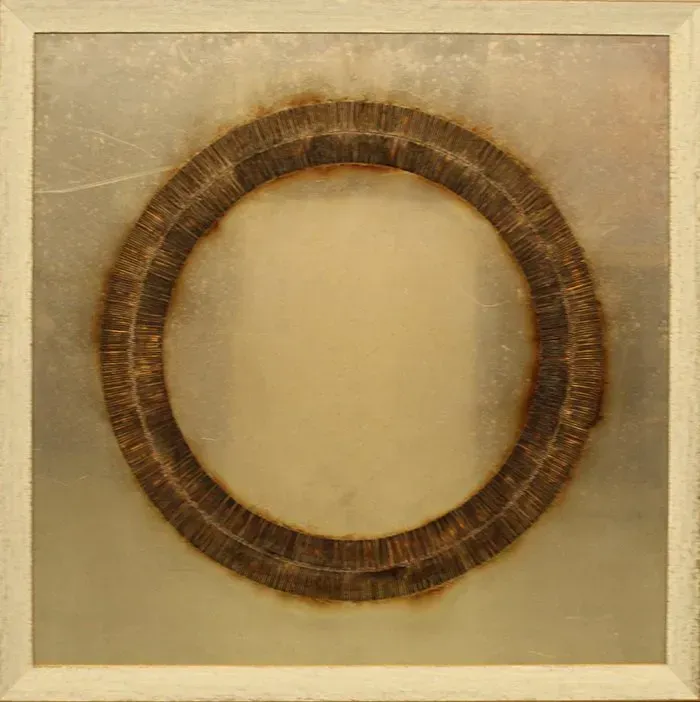
Bernard Aubertin
3 Available Works
Biography
Bernard Aubertin (1934–2015) was a French artist and a vital figure of the ZERO movement, renowned for his uncompromising monochrome red works and radical use of fire as a creative force. From his seminal Tableaux Rouges to combusted match and nail reliefs, Aubertin explored the thresholds between creation and destruction,...
Bernard Aubertin (1934–2015) was a French artist and a vital figure of the ZERO movement, renowned for his uncompromising monochrome red works and radical use of fire as a creative force. From his seminal Tableaux Rouges to combusted match and nail reliefs, Aubertin explored the thresholds between creation and destruction, time and energy. His work has been widely exhibited and remains influential within postwar and contemporary avant‑garde discourse.
Born in 1934 near Paris, Bernard Aubertin emerged in the late 1950s with a singular vision that would define his career. A pivotal encounter with Yves Klein’s monochromes in 1958 catalyzed Aubertin’s commitment to the absolute of color, leading him to dedicate himself to red as a total field—both material and metaphysical. By the turn of the 1960s he aligned with the international ZERO network, sharing its pursuit of a reset in postwar art: a move toward clarity, energy, and the reduction of ego in favor of elemental phenomena. Aubertin’s early Tableaux Rouges established his idiom: densely worked planes of red pigment that transformed the canvas into a site of vibration and intensity. From there he extended painting into relief and action, creating rhythmic surfaces with hammered nails and structuring canvases with meticulously arranged matches—then igniting them so that fire completed the composition. In his Combustions, burned books and charred panels, he made flame a co‑author, allowing chance, heat, and time to inscribe the work. These “actions of fire” were not spectacle alone; they were rigorous inquiries into the material limits of painting and the choreography of entropy. Influenced by the radical reductions of Klein, the spatial investigations of Fontana, and the experimental ethos of ZERO, Aubertin sought a zero‑degree of painting where gesture yields to process and phenomena. Red, for Aubertin, was not merely a color but a totality—life force, danger, ritual—capable of containing both presence and void. By courting risk and welcoming indeterminacy, he forged a philosophy in which the artist sets conditions and the work is completed by the energies it summons: combustion, rhythm, and the passage of time. From the 1960s onward Aubertin’s work was exhibited across Europe in key ZERO group presentations and numerous solo shows, with renewed international attention in the 2000s and 2010s. His contributions have been recognized in major retrospectives on ZERO, including museum surveys that reappraised the movement’s global reach. Aubertin died in 2015 in Reutlingen, Germany, leaving a legacy of works in prominent public and private collections and an enduring influence on contemporary practices that engage matter, monochrome, and performance of process.
Artistic Statement
"I seek the point where painting surrenders to phenomena—where red, as total presence, becomes a field for energy, rhythm, and risk. By setting conditions for fire, chance, and time, I let the work complete itself, revealing creation and destruction as two faces of the same act."
All Works
Explore all works by Bernard Aubertin, including works that are no longer available.

Tableau Clous (1961)
A dense monochrome field of saturated red is punctuated by an ordered constellation of iron nails, their heads articulating a low relief that animates the surface with measured rhythm and light. Driven at regular intervals across the support, the clous transform the painting into a tactile matrix: metallic highlights flare and recede against the red ground, while the physical penetration of the nails compresses and stresses the plane, converting color into structure. Aubertin’s calibrated spacing and depth produce a vibratory optical effect—an austere but sensorial choreography in which repetition, seriality, and the elemental force of red cohere into a rigorously constructed relief painting.Created in 1961, this Tableau Clous is an early-period work from the moment Aubertin expanded his Tableaux Rouges into relief and action, aligning with the ZERO movement’s postwar reset toward clarity and phenomena. In dialogue with contemporaries exploring monochrome and material processes (from Yves Klein’s chromatic absolutism to the serial reliefs that define ZERO’s vocabulary), Aubertin’s nails enact a zero-degree of painting: gesture yields to procedure, and light, surface, and time become the true agents of form—a position that presages his Combustions and fire paintings while retaining the disciplined intensity of Minimal Art. Documented under the archival reference TCLR16-1000395423 and emerging from a Private Collection in Italy, the work bears strong provenance and scholarly traceability; works from this cycle have been contextualized in international museum surveys of ZERO and are present in public collections. For collectors, an early 1961 nail painting represents a significant example from the artist’s definitive period and a museum-grade acquisition within the canon of European avant-garde relief and monochrome. An elemental monochrome animated by serial relief, the work crystallizes Aubertin’s zero-degree painting at the moment of its emergence.
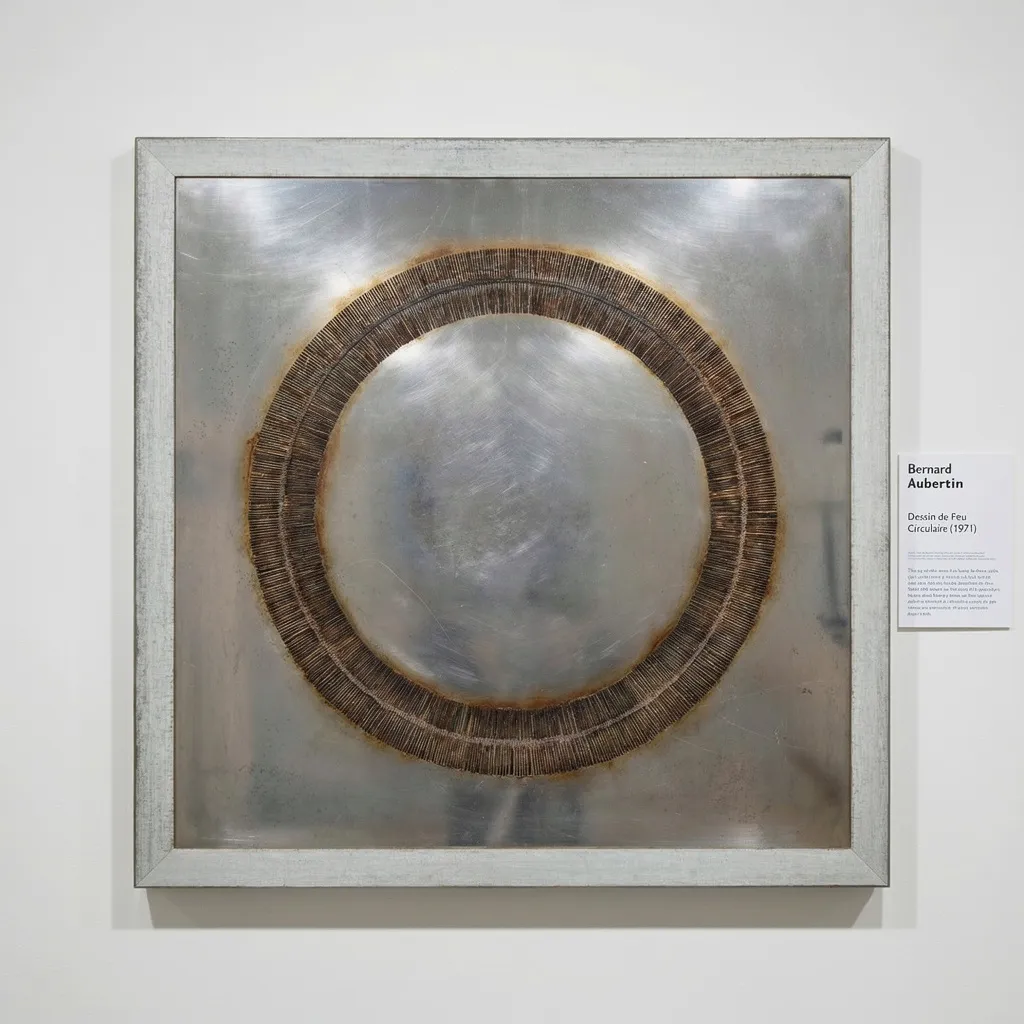
Dessin de Feu Circulaire (1971) (1971)
Bernard Aubertin’s Dessin de Feu Circulaire (1971) presents a disciplined circular inscription wrought directly by flame on a metal support: a ring of matchsticks was meticulously aligned and ignited so that heat and combustion drew the work’s form. The industrial surface registers the event—scorched halos, subtle oxidations, and residues of char—while the surviving fragments of matches punctuate the circumference with a cadence of blackened and ashen intervals. As in Aubertin’s most rigorous actions of fire, the artist establishes the structure and the material conditions, and then yields the completion of the drawing to energy itself; here, the circle becomes both geometry and process, a controlled locus for entropy and time.Created in 1971, the work belongs to Aubertin’s mid-career consolidation of his fire practice, extending the ZERO movement’s pursuit of a “zero-degree” of painting into a phenomenology of heat, risk, and chance. Emerging from his Tableaux Rouges and match reliefs of the early 1960s—and catalyzed by Yves Klein’s monochromes and the experimental ethos shared with Lucio Fontana—Aubertin’s Dessins de Feu formalize the act of combustion as drawing, with the circular motif resonating as a sign of origin, void, and return. With provenance to Galleria Centro and Galleria Dalìano Ribani, and documented in the artist’s archive under DFEA17-1000199523, the piece carries strong institutional-ready credentials; works from this fire corpus have been repeatedly contextualized in museum surveys of ZERO and postwar European avant-garde. A museum-grade example of Aubertin’s definitive “fire painting” method, this documented 1971 Dessin de Feu offers collectors a rare, collection-worthy articulation of process at the threshold of material and time, where the circle anchors the zero-degree of image and event.
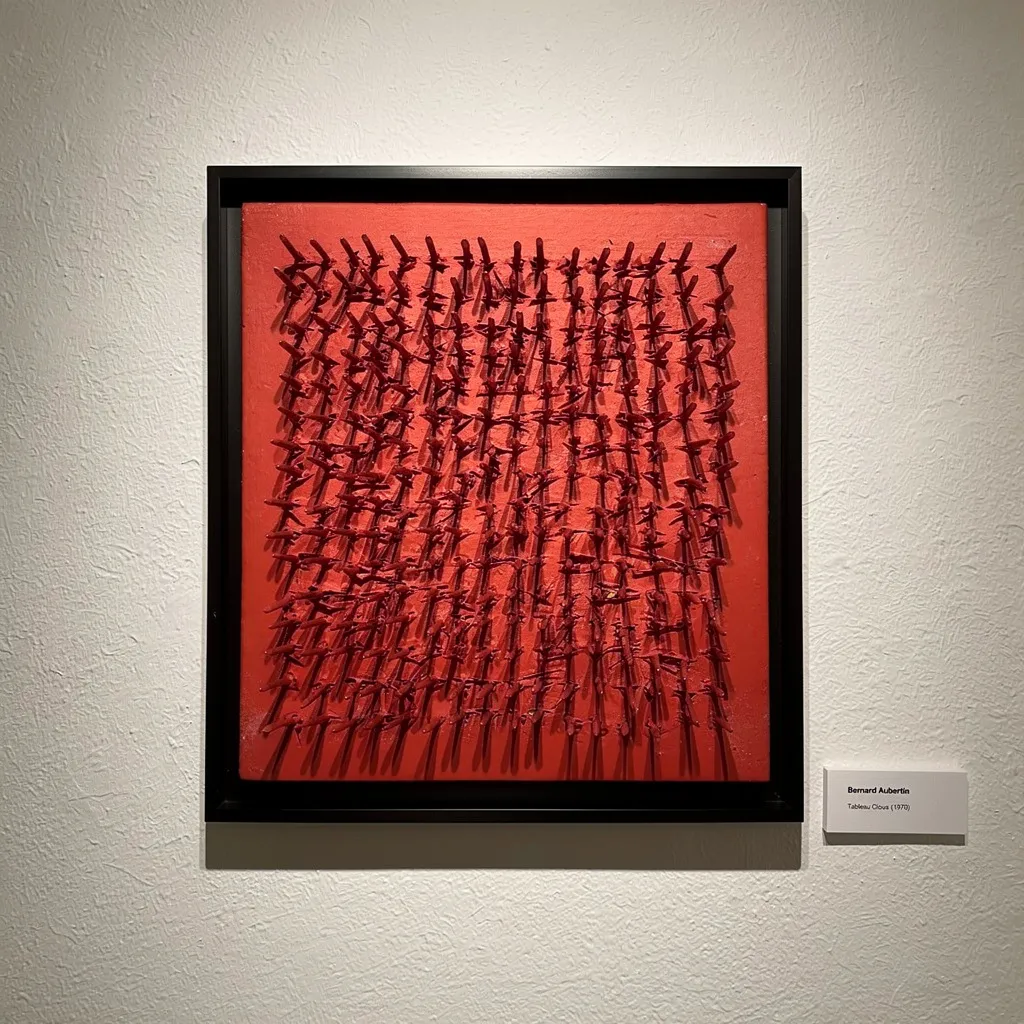
Tableau Clous (1970)
A saturated red monochrome coalesces into relief: an orchestration of industrial nails driven rhythmically into the support and unified under a single, incandescent field of red. The hammered matrix—heads catching light, shanks casting minute shadows—creates a vibrating topography where the surface itself becomes an instrument of measure and perception. Aubertin’s Tableau Clous channels a ritualized, serial action: the hammering is method and mark alike, replacing expressive brushwork with a calibrated cadence that inscribes duration and physical energy into matter. The red field operates as totality and veil, binding metal and ground into one optical and tactile continuum, while the varying incidence of light across the nail heads activates the work’s phenomenological pulse.Created in 1970, this work belongs to Aubertin’s mature ZERO continuum, a decisive phase in which his monochrome investigations expanded from the early Tableaux Rouges into relief (nails) and action (matches and combustions). Post-1960s and in dialogue with the ZERO movement’s “reset” of painting—alongside Klein’s chromatic absolutism and Fontana’s spatial incision—Aubertin pursued a zero-degree of image where authorship yields to process, seriality, and elemental phenomena. Within this period, the Tableau Clous corpus stands as a canonical articulation of monochrome relief, aligning with contemporaneous Minimal Art and postwar avant-garde reductions while retaining the charged symbolism of red as life force and limit. Documented under archive no. TCLR86-1000433723 and bearing Italian provenance from Christiano Art Gallery, the work is securely situated within the artist’s recognized oeuvre; related nail and fire works have been foregrounded in major ZERO surveys and institutional reappraisals. For collectors, a 1970 Tableau Clous is a significant example from the artist’s definitive period—museum-grade both in historical import and material rigor. A lucid manifestation of ZERO’s reset, this Tableau Clous unites monochrome discipline with rhythmic relief to render time, energy, and light as the very substance of painting.
Interested in More Works?
Contact us for information about upcoming works or commissions by Bernard Aubertin.
Inquire About More Works