
Zao Wou‑Ki’s Monumental East–West Abstraction
Zao Wou‑Ki united the pulse of Chinese ink with the expanses of European abstraction, crafting monumental paintings and resonant works on paper. This curated essay reads materials, techniques, and philosophy to position collectors with clarity.
Zao Wou‑Ki’s name has become synonymous with a rare equilibrium: an East–West synergy in monumental abstraction that feels both ancient and newly lit. In his paintings and works on paper, Chinese ink traditions—rhythm, void, breath—meet European research in color, gesture, and scale. The result is an art where spatial infinity finds material form, and time’s memory becomes surface.
For contemporary viewers and collectors, Zao’s achievement matters because it fuses two lineages that often remain separated: literati brushwork and Western abstraction. His canvases and papers do not illustrate landscape; they stage it as a felt, open field—a place where pigment’s atmosphere and calligraphic pulse invite perception to slow and deepen. Reading these works means understanding how materials and technique carry philosophy.
Zao Wou‑Ki’s East–West Language
At the conceptual core is a dialogue between traditions of seeing. From the East, Zao inherits the primacy of brush rhythm and the poetics of the void; from the West, he embraces the autonomy of abstraction and the insistence on matter as meaning. In practice, this yields compositions where no single motif dominates. Instead, layers of color and calligraphic radiances create an immersive field that resists narrative and rewards attentiveness.
Such synergy is not eclecticism. It is structural: void is not empty—void is generative. Ink is not outline—ink is atmosphere. Zao’s abstraction is less about abandoning the world than distilling it into forces: wind, light, turbulence, calm. The paintings invite the eye to travel across micro-events—soft dissolves, sharp accents, translucent veils—where East–West is experienced as a continuous, breathing space.
For those encountering the work at scale, the East–West language reads as spatial ethics: the canvas becomes a site for presence rather than a window to elsewhere. This is how monumentality in Zao Wou‑Ki avoids spectacle. It builds a calm intensification, a room within a room where seeing is disciplined and expanded.
Materials, Scale, and Technique
Zao’s material intelligence is precise. In oil painting, he often builds surfaces through layered glazes—thin, translucent films that modulate light with depth—interleaved with more opaque passages to structure rhythm. Glazing slows time: each layer must dry and settle, allowing subsequent films to interact optically. The effect is an internal luminosity, as if the light is not on the painting but inside it.
Wet‑in‑wet areas introduce soft transitions and atmospheric gradients; dry brush and scumbling articulate edges that remain organic rather than hard, keeping the field porous. Primed linen can be read beneath translucent zones, its weave contributing a subtle grain to the image. In darker passages, earth pigments anchor the composition, while cooler chroma—blues, greys, violets—open zones of breath and distance.
Ink and watercolor works transpose these principles to paper with tactility. Different papers—sized or unsized, with varied tooth—change the behavior of wash and line. Ink can bleed or sit, depending on the fiber and sizing; watercolor’s granulation can create delicate terrains. Zao’s control of water and pigment thus mirrors his oil method: layers, pauses, and interplays that build a spatial resonance without literal depiction.
Rhythm, Void, and Gesture
Philosophically, Zao’s abstraction is grounded in rhythm—the cadence of marks, the alternation of density and air. The void (empty space) is not a background but a partner to gesture, shaping movement and stillness. When viewers refer to his works as landscapes, they often mean a felt geography of forces rather than a place: zones of compression alongside fields of release, eddies of line against large expanses of translucent color.
Gesture here is calibrated, not improvised spectacle. Even when brushstrokes surge, they do so within a larger respiration. The interplay of fast marks and slow veils constructs temporal layers. One sees not only what pigment does but how long it has been allowed to do it—the patience of drying, the return of the hand, the refusal to seal the surface prematurely.
This approach situates Zao within postwar abstraction while retaining a distinct calligraphic conscience. Gestural energy is present, yet it is disciplined by the poetics of breathing space. The outcome is a language that feels inevitable rather than decorative—each element justified by the whole.
Monumentality and Spatial Experience
The term “monumental” for Zao Wou‑Ki signals not size alone but spatial conduct. Large canvases create a field where the viewer’s body becomes a measuring instrument. Peripheral vision engages; small chromatic events, barely legible from a distance, emerge as one approaches. The painting changes as the viewer moves, turning scale into experience rather than mere dimension.
Monumentality also describes duration. Broad color fields in dialogue with concentrated gestural nodes slow perception, asking attention to traverse the work over time. In this sense, Zao’s paintings are temporal architecture. They hold, release, and reconfigure looking through orchestrated intervals—quiet plateaus, sudden intensifications, then a return to equilibrium.
Collectors who live with such works discover their cyclical qualities: morning light reveals atmospheric strata; evening light emphasizes structural pivots in darker zones. Each day modifies the painting’s internal weather, confirming that light is a material in Zao’s vocabulary, as vital as pigment, brush, and ground.
Featured Works
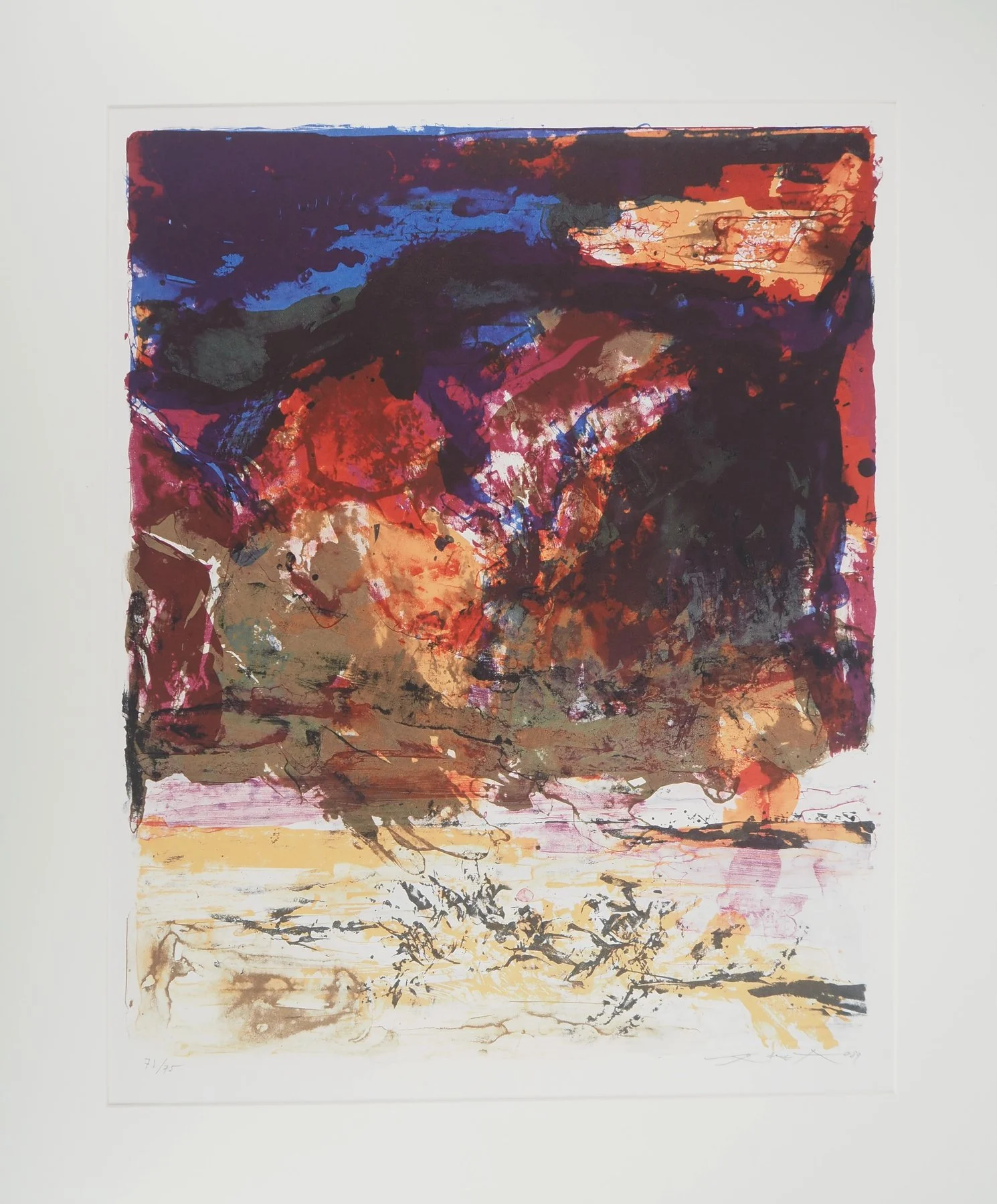
Zao Wou‑Ki on Paper and Print
Works on paper—ink, watercolor, and editioned prints—extend Zao’s language with intimacy. Ink drawings concentrate rhythm into essential gestures; watercolor unfolds atmospheric veils with speed and clarity. These pieces offer direct access to the artist’s breath and hand, often revealing compositional seeds later expanded on canvas.
In prints, lithography and intaglio serve different ends. Lithography translates drawing and wash into editioned form, preserving calligraphic flow and soft tonalities; intaglio—etching and aquatint—builds rich, granular fields and sharpened contrasts. Paper choice and plate work shape the mood: smoother papers keep line crisp, while textured sheets deepen tone.
Edition signals matter for connoisseurship: number fractions (e.g., 23/99), signatures, and occasional printer’s or workshop marks watchfully confirm process and scarcity. For a deeper guide to reading Zao’s prints and papers—materials, signatures, and presentation—see Ink, Light, Infinity: Collecting Zao Wou‑Ki. The principles there pair well with this essay’s attention to technique and philosophy.
Collecting with Connoisseurship
Selecting a Zao Wou‑Ki work benefits from patient looking and material literacy. On canvas, attend to surface integrity: layered glazes can be vulnerable to abrasion; inspect for craquelure in thicker passages and note any over‑cleaning that flattens micro‑translucencies. Proper framing with breathing space—avoid tight, heavy frames—respects the work’s spatial ethic.
On paper, check for acidification, foxing, or mat burn. Prefer conservation framing: pH‑neutral mounts, hinges made for fine papers, and UV‑filter glazing to protect delicate washes. For prints, ensure edition clarity and watch for discoloration around margins where previous mats may have sat. Paper tone should remain coherent across image and border.
Connoisseurship also means context. Zao Wou‑Ki’s East–West synthesis aligns with postwar abstraction while offering a unique calligraphic intelligence. Collections that foreground material and spatial rigor—alongside a sensitivity to rhythm and void—will find his works eloquent partners to both European and Asian avant‑gardes. The measure of quality is not size or saturation alone but the coherence of breath, layers, and light.
Conclusion
Zao Wou‑Ki’s monumental abstraction is a continuous negotiation between matter and air—between gesture’s urgency and the generative calm of the void. In the fusion of East–West languages, he achieves a grammar of light and rhythm that feels both rooted and open.
For collectors and admirers, this synergy offers not fashion but durational value: works that deepen with attention, conserve their spatial charge, and converse fluently with diverse holdings. Read the surfaces, trust the breath, and let the paintings and papers teach you how to see across traditions—quietly, precisely, and with enduring pleasure.