Dessin de Feu Circulaire (1971) (1971) by Bernard Aubertin
Provenance & Documentation
Galleria Centro; Galleria Dalìano Ribani
DFEA17-1000199523
About This Artwork
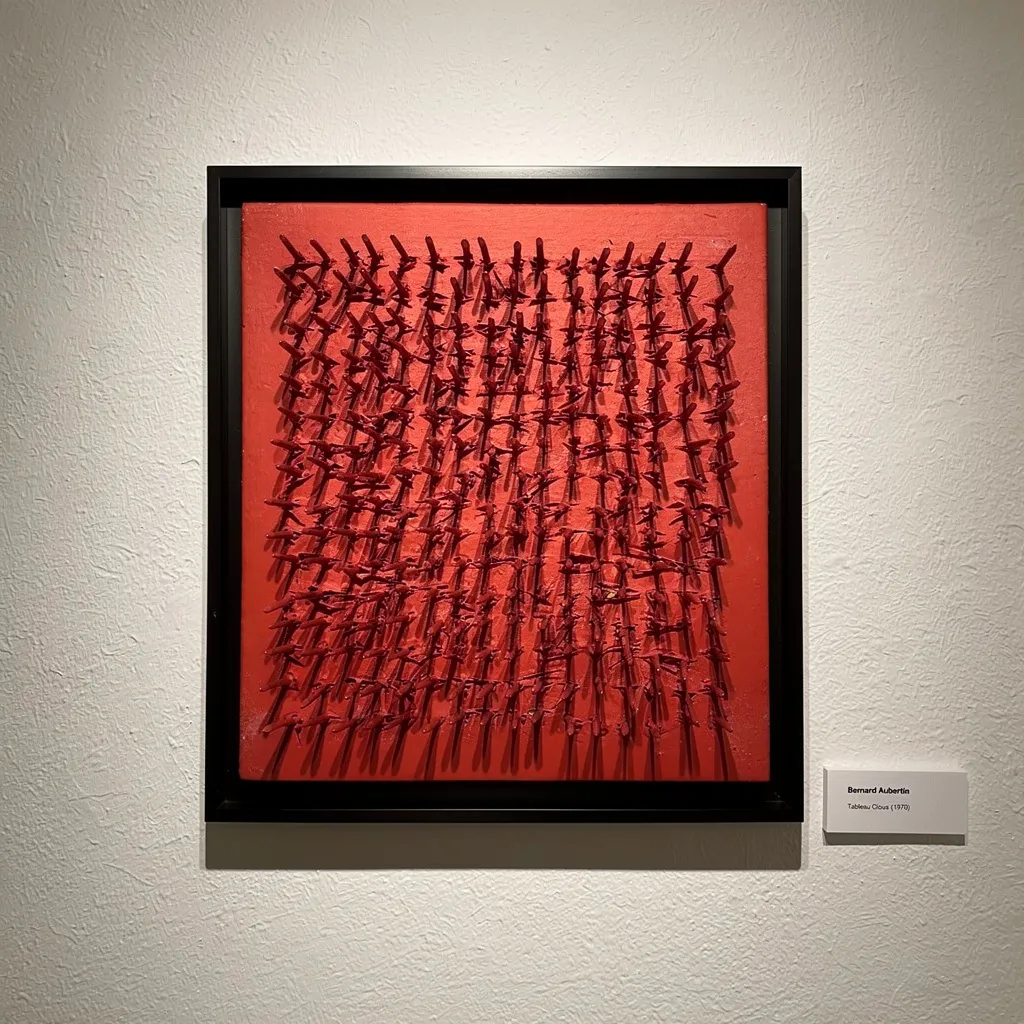
Bernard Aubertin’s Dessin de Feu Circulaire (1971) presents a disciplined circular inscription wrought directly by flame on a metal support: a ring of matchsticks was meticulously aligned and ignited so that heat and combustion drew the work’s form. The industrial surface registers the event—scorched halos, subtle oxidations, and residues of char—while the surviving fragments of matches punctuate the circumference with a cadence of blackened and ashen intervals. As in Aubertin’s most rigorous actions of fire, the artist establishes the structure and the material conditions, and then yields the completion of the drawing to energy itself; here, the circle becomes both geometry and process, a controlled locus for entropy and time.
Created in 1971, the work belongs to Aubertin’s mid-career consolidation of his fire practice, extending the ZERO movement’s pursuit of a “zero-degree” of painting into a phenomenology of heat, risk, and chance. Emerging from his Tableaux Rouges and match reliefs of the early 1960s—and catalyzed by Yves Klein’s monochromes and the experimental ethos shared with Lucio Fontana—Aubertin’s Dessins de Feu formalize the act of combustion as drawing, with the circular motif resonating as a sign of origin, void, and return. With provenance to Galleria Centro and Galleria Dalìano Ribani, and documented in the artist’s archive under DFEA17-1000199523, the piece carries strong institutional-ready credentials; works from this fire corpus have been repeatedly contextualized in museum surveys of ZERO and postwar European avant-garde. A museum-grade example of Aubertin’s definitive “fire painting” method, this documented 1971 Dessin de Feu offers collectors a rare, collection-worthy articulation of process at the threshold of material and time, where the circle anchors the zero-degree of image and event.