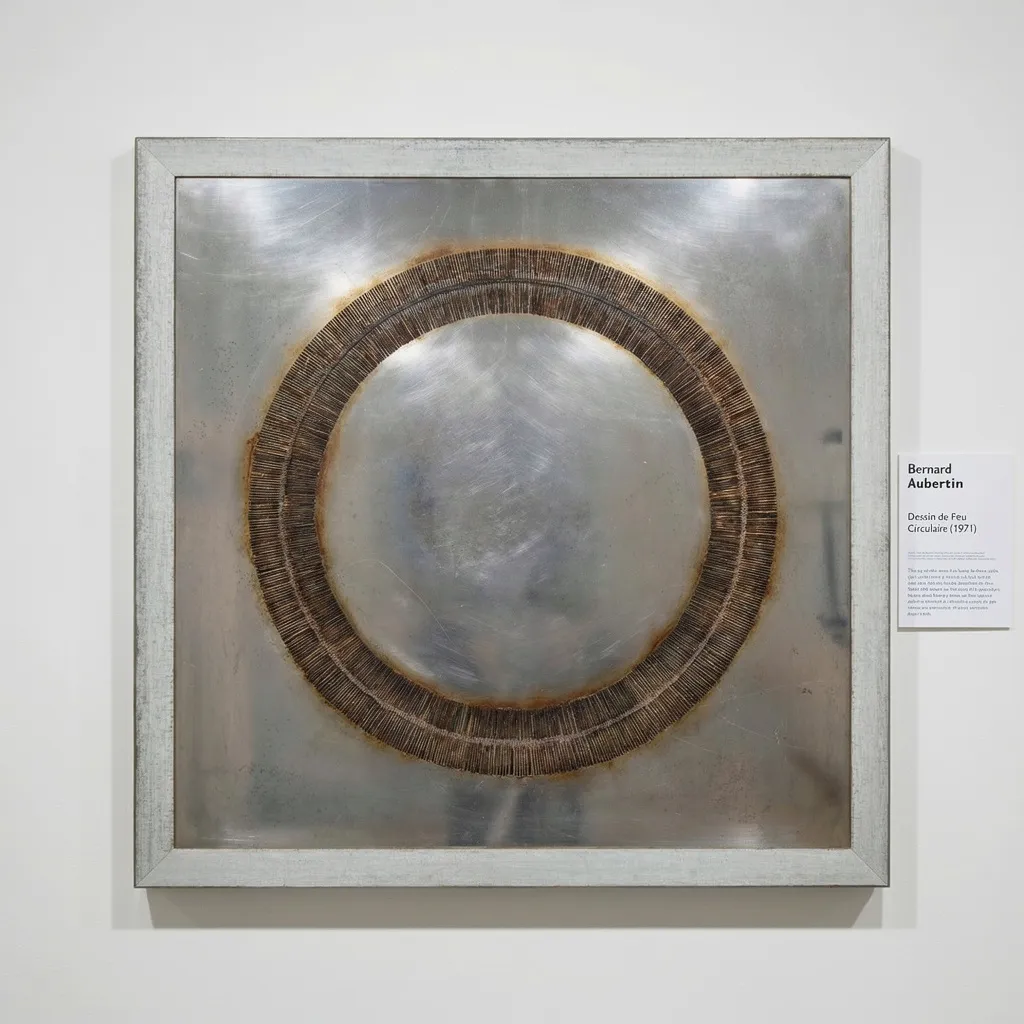
Tableau Clous (1970) by Bernard Aubertin
Provenance & Documentation
Christiano Art Gallery, Italy
TCLR86-1000433723
About This Artwork
A saturated red monochrome coalesces into relief: an orchestration of industrial nails driven rhythmically into the support and unified under a single, incandescent field of red. The hammered matrix—heads catching light, shanks casting minute shadows—creates a vibrating topography where the surface itself becomes an instrument of measure and perception. Aubertin’s Tableau Clous channels a ritualized, serial action: the hammering is method and mark alike, replacing expressive brushwork with a calibrated cadence that inscribes duration and physical energy into matter. The red field operates as totality and veil, binding metal and ground into one optical and tactile continuum, while the varying incidence of light across the nail heads activates the work’s phenomenological pulse.
Created in 1970, this work belongs to Aubertin’s mature ZERO continuum, a decisive phase in which his monochrome investigations expanded from the early Tableaux Rouges into relief (nails) and action (matches and combustions). Post-1960s and in dialogue with the ZERO movement’s “reset” of painting—alongside Klein’s chromatic absolutism and Fontana’s spatial incision—Aubertin pursued a zero-degree of image where authorship yields to process, seriality, and elemental phenomena. Within this period, the Tableau Clous corpus stands as a canonical articulation of monochrome relief, aligning with contemporaneous Minimal Art and postwar avant-garde reductions while retaining the charged symbolism of red as life force and limit. Documented under archive no. TCLR86-1000433723 and bearing Italian provenance from Christiano Art Gallery, the work is securely situated within the artist’s recognized oeuvre; related nail and fire works have been foregrounded in major ZERO surveys and institutional reappraisals. For collectors, a 1970 Tableau Clous is a significant example from the artist’s definitive period—museum-grade both in historical import and material rigor. A lucid manifestation of ZERO’s reset, this Tableau Clous unites monochrome discipline with rhythmic relief to render time, energy, and light as the very substance of painting.