Contemporary Artworks
Explore curated contemporary artworks from talented artists worldwide. Shop original paintings, prints & unique art pieces today. Free shipping over 500 CHF.
All Artworks

Nous
Henry Escobar's Nous unfurls like a quiet revelation: a field of luminous, layered color punctuated by disciplined strokes and delicate constellations of mark-making. Veils of translucent pigment glide across the surface, meeting passages of velvety opacity and crisp, intentional edges; subtle metallic accents catch the light while fine scored lines and lifted passages reveal the strata beneath. The artist's hand is palpable - measured, assured, and textural - balancing fluent gesture with immaculate control to build a mixed-media surface that is both sensorially rich and serenely composed.Taking its title from the concept of nous - at once mind and we - this work meditates on the shared intelligence that binds individual experience to collective meaning. Escobar channels the lineage of postwar abstraction through a contemporary lens, using restraint, rhythm, and negative space to invite contemplation as much as visual pleasure. Elegant yet quietly powerful, Nous is a poised centerpiece for sophisticated interiors, from tailored living rooms and curated salons to refined corporate spaces; its nuanced palette and polished craftsmanship harmonize effortlessly with natural materials, sculptural furnishings, and clean architectural lines, making it a compelling acquisition for collectors attuned to both intellect and atmosphere.

Panda boxe (2023)
The "Panda Boxe" sculpture by French artist Naor captures the essence of playful yet provocative contemporary art. Blending his distinctive Pop Art influences, Naor infuses this piece with a striking combination of innocence and aggression. The panda, a symbol of softness and peace, is juxtaposed with boxing gloves—representing strength and conflict. This duality is central to Naor’s artistic identity, where his works often reflect the tension between gentleness and violence. Naor, known for incorporating luxury and popular culture elements, adds a contemporary edge to the panda figure, merging humor and commentary on societal values. The sculpture’s glossy finish and vibrant colors make it not just a visual statement but a conversation piece. The use of high-quality resin and meticulous craftsmanship elevate this playful figure into a sophisticated work of art. Inspired by his travels and global experiences, Naor’s sculptures often explore cultural contradictions, and "Panda Boxe" is no exception. It invites viewers to ponder the tension between innocence and struggle, luxury and simplicity, ultimately offering a reflection on life’s contrasts.

Picsou Louis Vuitton (2023)
The figure, standing confidently on a sleek black pedestal, clutches two gleaming Dom Pérignon bottles, each with a glossy black finish and striking emerald green labels, further emphasizing the indulgent celebration of wealth. Topped with a monogrammed hat, the character’s headgear reinforces the theme of refined extravagance. The face and hands, rendered in a golden hue, provide a captivating visual contrast to the figure’s reflective surfaces, which dynamically capture and play with light, highlighting the sculpture’s intricate details. This piece is not merely a decorative object but a bold statement that challenges the traditional boundaries of art. By incorporating elements of fashion, luxury, and lifestyle, the sculpture invites viewers to explore the intersections of art, consumer culture, and societal values. Its vibrant presence transforms any space, demanding attention and inspiring contemplation on the meaning of extravagance in contemporary culture.

Snoopy e Woodstock insieme 1 (2024)
Celebrate the timeless charm of Charles Schulz’s iconic characters with “Snoopy e Woodstock Insieme,” a delightful artwork by Eghna from 2024. This enchanting piece brings to life the playful and endearing relationship between Snoopy and Woodstock with vibrant colors and a whimsical composition. Eghna’s masterful depiction captures the spirit of these beloved characters in a way that is both nostalgic and fresh. The artwork’s joyful energy and attention to detail make it an ideal choice for Peanuts enthusiasts or anyone looking to add a touch of fun and personality to their space. “Snoopy e Woodstock Insieme” stands out as a testament to the enduring appeal of these classic characters, offering a cheerful and artistic homage that will brighten up any room. Perfect for collectors and fans alike, this piece is sure to be a cherished addition to any art collection.

Soucieuse XL
Soucieuse XL by Henry Escobar commands the room with an immersive, large-format presence, its title casting a pensive hush across a refined, contemporary field. The composition breathes through layered veils and disciplined mark-making, where soft gradations meet crisp, decisive contours. Texture is orchestrated with exacting control—built through additive and subtractive processes of layering, gentle erasures, and measured reworking—so the surface slips from silky calm to subtly abraded passages that catch and release light. Escobar balances gesture with precision, allowing negative space to carry as much weight as the marks themselves, yielding a poised equilibrium of tension and serenity.At once introspective and architectural, Soucieuse XL advances Escobar’s exploration of how thought becomes form—an elegant dialogue between restraint, memory, and the immediacy of the hand. Its clarity of structure and contemplative mood make it a compelling acquisition for collectors who value works that reward prolonged looking and anchor sophisticated spaces. Scaled to hold its own in a modern living room, an architect-led entry, or an executive suite, the piece harmonizes with minimalist lines, tactile stone, and warm woods, while its nuanced palette complements both monochrome and richly layered interiors. A refined statement work from Henry Escobar, it offers enduring presence and museum-caliber poise for the most discerning collections.

Stewie no problem (2024)
Inject a dose of humor and personality into your decor with “Stewie No Problem,” a standout piece by Eghna from 2024. This captivating artwork features Stewie Griffin, the beloved and often mischievous character from Family Guy, portrayed with vibrant colors and a playful attitude. Eghna’s depiction of Stewie captures the essence of his cheeky charm and wit, making this piece a delightful addition for fans of the show or collectors of unique and humorous art. The bold use of color and dynamic composition add an energetic flair that makes the artwork a focal point in any room. “Stewie No Problem” brings a touch of fun and character to your space, showcasing Eghna’s ability to blend pop culture with artistic creativity. This piece is perfect for brightening up living rooms, offices, or any area in need of a whimsical touch.

Tableau Clous (1961)
A dense monochrome field of saturated red is punctuated by an ordered constellation of iron nails, their heads articulating a low relief that animates the surface with measured rhythm and light. Driven at regular intervals across the support, the clous transform the painting into a tactile matrix: metallic highlights flare and recede against the red ground, while the physical penetration of the nails compresses and stresses the plane, converting color into structure. Aubertin’s calibrated spacing and depth produce a vibratory optical effect—an austere but sensorial choreography in which repetition, seriality, and the elemental force of red cohere into a rigorously constructed relief painting.Created in 1961, this Tableau Clous is an early-period work from the moment Aubertin expanded his Tableaux Rouges into relief and action, aligning with the ZERO movement’s postwar reset toward clarity and phenomena. In dialogue with contemporaries exploring monochrome and material processes (from Yves Klein’s chromatic absolutism to the serial reliefs that define ZERO’s vocabulary), Aubertin’s nails enact a zero-degree of painting: gesture yields to procedure, and light, surface, and time become the true agents of form—a position that presages his Combustions and fire paintings while retaining the disciplined intensity of Minimal Art. Documented under the archival reference TCLR16-1000395423 and emerging from a Private Collection in Italy, the work bears strong provenance and scholarly traceability; works from this cycle have been contextualized in international museum surveys of ZERO and are present in public collections. For collectors, an early 1961 nail painting represents a significant example from the artist’s definitive period and a museum-grade acquisition within the canon of European avant-garde relief and monochrome. An elemental monochrome animated by serial relief, the work crystallizes Aubertin’s zero-degree painting at the moment of its emergence.
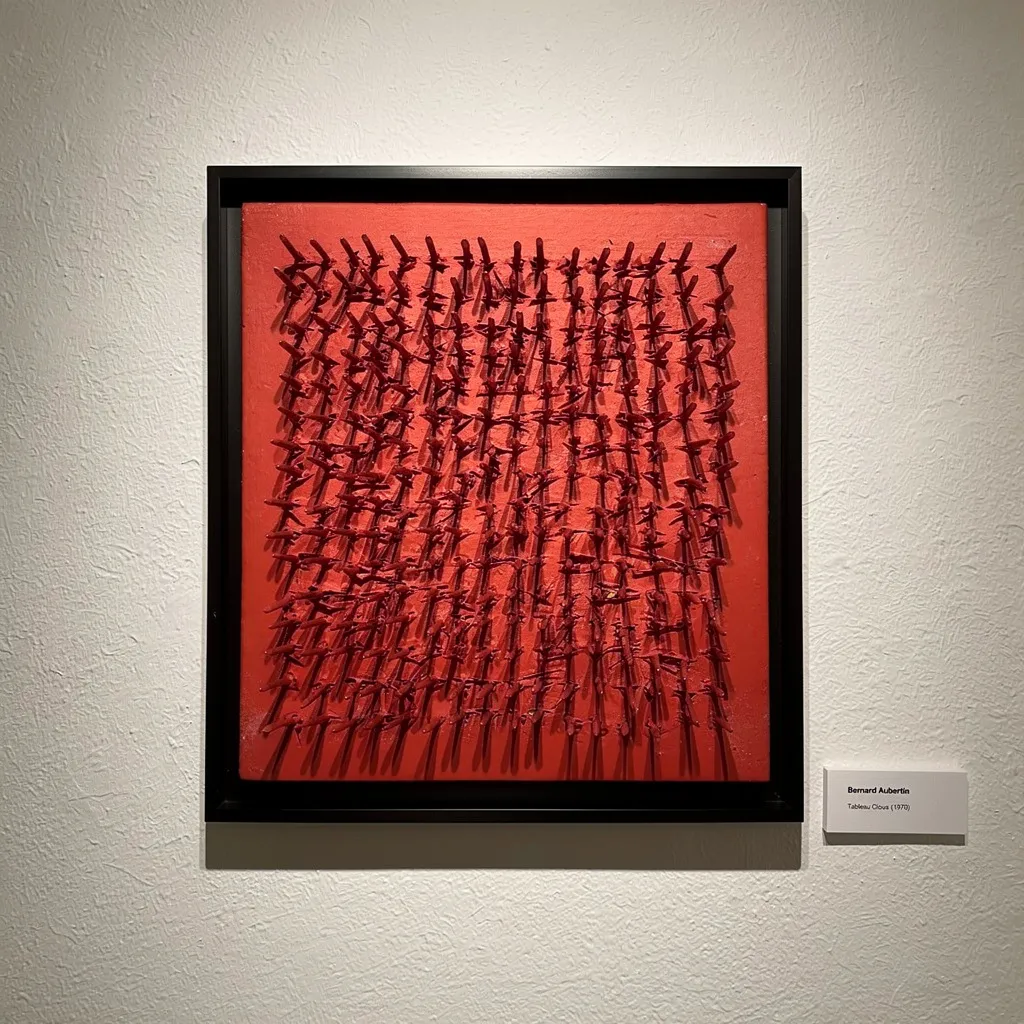
Tableau Clous (1970)
A saturated red monochrome coalesces into relief: an orchestration of industrial nails driven rhythmically into the support and unified under a single, incandescent field of red. The hammered matrix—heads catching light, shanks casting minute shadows—creates a vibrating topography where the surface itself becomes an instrument of measure and perception. Aubertin’s Tableau Clous channels a ritualized, serial action: the hammering is method and mark alike, replacing expressive brushwork with a calibrated cadence that inscribes duration and physical energy into matter. The red field operates as totality and veil, binding metal and ground into one optical and tactile continuum, while the varying incidence of light across the nail heads activates the work’s phenomenological pulse.Created in 1970, this work belongs to Aubertin’s mature ZERO continuum, a decisive phase in which his monochrome investigations expanded from the early Tableaux Rouges into relief (nails) and action (matches and combustions). Post-1960s and in dialogue with the ZERO movement’s “reset” of painting—alongside Klein’s chromatic absolutism and Fontana’s spatial incision—Aubertin pursued a zero-degree of image where authorship yields to process, seriality, and elemental phenomena. Within this period, the Tableau Clous corpus stands as a canonical articulation of monochrome relief, aligning with contemporaneous Minimal Art and postwar avant-garde reductions while retaining the charged symbolism of red as life force and limit. Documented under archive no. TCLR86-1000433723 and bearing Italian provenance from Christiano Art Gallery, the work is securely situated within the artist’s recognized oeuvre; related nail and fire works have been foregrounded in major ZERO surveys and institutional reappraisals. For collectors, a 1970 Tableau Clous is a significant example from the artist’s definitive period—museum-grade both in historical import and material rigor. A lucid manifestation of ZERO’s reset, this Tableau Clous unites monochrome discipline with rhythmic relief to render time, energy, and light as the very substance of painting.

The Kid- Chaplin and the Boy (2024)
"The Kid – Chaplin and the Boy" by Spanish artist Joaquim Falcó is an exceptional piece of Pop Art, inspired by the iconic Charlie Chaplin film The Kid. Created using acrylic on high-quality giclée canvas, the artwork showcases Falcó’s bold, vibrant color palette and his characteristic modern, expressive style. This painting captures the heartfelt connection between Chaplin and the boy, blending nostalgia with contemporary aesthetics. Falcó’s work has been showcased in over 400 exhibitions worldwide, establishing him as a leading figure in the Pop Art movement. His use of cultural icons, especially in this tribute to Chaplin, highlights his ability to merge popular culture with fine art. The piece is hand-signed by the artist on both the front and back, guaranteeing authenticity, and is shipped directly from his studio, rolled in a protective tube. It also comes with a certificate of authenticity, making it a perfect acquisition for collectors of contemporary art or film memorabilia. Joaquim Falcó's works, known for their vibrant energy and connection to popular culture, have a broad appeal to art enthusiasts worldwide, particularly those with an interest in cinematic history. This one-of-a-kind artwork is a statement piece that blends classic cinema with the edgy flair of contemporary Pop Art, making it an outstanding addition to any art collection.